
Trees
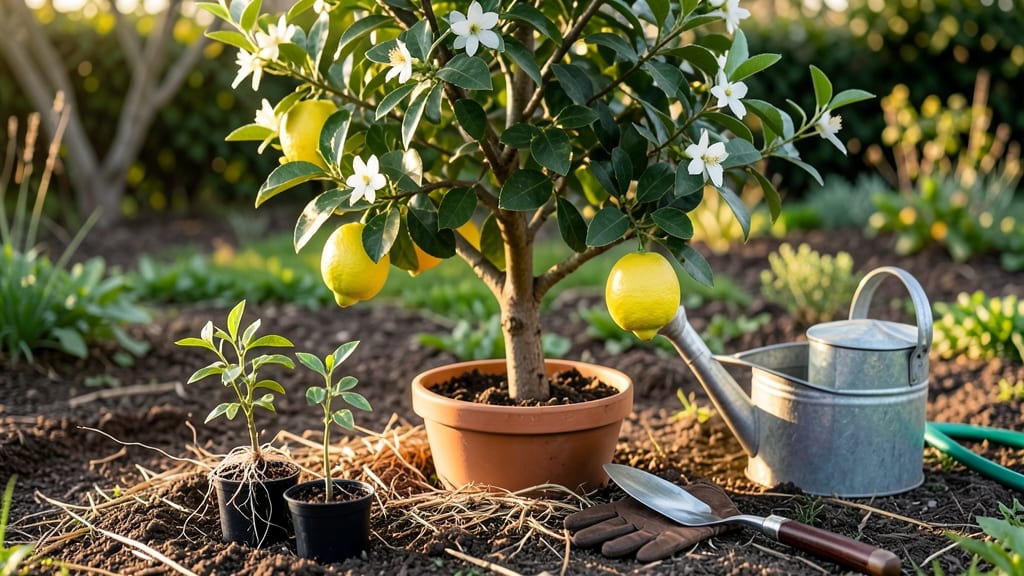
Planting lemon trees in Texas after your last frost date — typically between mid-February and late March — sets your tree up for a strong start before summer’s heat arrives.
Texas gardeners know timing is everything — plant too early, and a late frost could wipe out your investment. Too late, and your tree might struggle to establish roots before summer’s brutal heat.
Here’s the exact planting schedule tailored to Texas’ five distinct microclimates, so you can grow a thriving 🍋 lemon tree year after year.
North Texas (like Dallas) has a longer frost window, while South Texas (Houston and beyond) can plant as early as January. Coastal areas near Galveston enjoy milder winters, while inland regions face harsher freezes.
Each zone has its own deadline, and missing it means risking transplant shock or stunted growth.
Below, I break down the best months by region, soil prep tips for Texas’ alkaline-heavy dirt, and how to protect young trees from both frost and summer’s intense sun. Let’s get your lemon tree off to the right start.
Texas microclimate planting Zones: when to plant lemon trees by region
Texas’ diverse climate means your lemon tree planting window depends entirely on where you live. In North Texas, late frosts can linger until mid-March, while South Texas gardeners might face hurricane season risks if planting too late.
Each region has its own frost-free deadlines and heat thresholds that determine success. Let’s break down the exact planting windows for Texas’ five key zones so you can avoid common pitfalls like transplant shock or winter dieback.
Lemon trees (Citrus × limon) thrive in USDA Zones 8-11, but Texas spans Zones 8a-10b. The key to success? Planting after the last average frost date but before summer’s brutal heat (typically after June 15).
For example, El Paso’s high desert (Zone 8a) has a March 15 frost-free date, while Houston’s humid subtropical climate (Zone 9a) rarely sees frost after January 1. Below, I’ve mapped out the optimal planting months for each region, including buffer periods for volatile years.
🌱 Pro Tip: Use your local Cooperative Extension Service frost data or the National Weather Service to confirm your exact last frost date. Even a 2-week delay can mean the difference between a thriving tree and one struggling through Texas’ triple-digit summers.
For North Texas (Dallas/Fort Worth), aim to plant Meyer lemon trees between March 15 and April 30. This window ensures your tree avoids late-spring frosts (which can occur as late as April 1) while giving roots time to establish before summer’s 100°F+ heat.
If you miss this window, consider container growing to move trees indoors during winter. In Central Texas (
How to adjust planting timing for lemon tree success: soil, variety, and heat tolerance
Texas’ alkaline-heavy soil and extreme heat demand smart adjustments to lemon tree planting schedules. Unlike coastal California, where lemons thrive year-round, Texas gardeners must account for frost risks in North Texas and summer transplant shock in South Texas.
The wrong variety choice or soil prep can turn your $50 tree into a $50 lesson.
Start with the right lemon variety. 'Meyer' lemons (Citrus × meyeri) tolerate colder temperatures down to 15°F, making them ideal for North and Central Texas.
Meanwhile, 'Eureka' or 'Lisbon' lemons prefer warmer climates (USDA Zones 9-11) and struggle below 25°F. Your choice directly impacts your planting window—sometimes by 2-3 months.
Soil preparation is your next critical move. Texas’ calcareous soil (pH 7.5-8.5) locks out essential nutrients like iron and zinc, causing chlorosis (yellow leaves). Amend the soil with 2-3 inches of compost and sulfur to lower pH to 6.0-7.0. For container growing, use a citrus-specific potting mix with perlite for drainage.
🌱 Texas Lemon Tree Planting Deadlines by Factor
Heat tolerance is where most Texas gardeners fail. Young lemon trees planted in peak summer (June–August) suffer transplant shock from 100°F+ temperatures. To acclimate, place newly planted trees under 30% shade cloth for 2-3 weeks, then gradually increase sun exposure.
For container-grown trees, move pots to a shaded patio during the hottest months.
Container growing offers flexibility but requires larger pots (15+ gallons) and drip irrigation to prevent root rot. In-ground plantings need mulch rings to retain moisture and windbreaks for coastal areas. Remember: lemon trees hate soggy roots—Texas’ clay-heavy soils need amended drainage or raised beds.
Pro tip: Plant bare-root trees in winter (December–February) for North Texas to capitalize on cooler temps and spring rains. In South Texas, fall planting (September–October) lets trees establish before summer’s intensity. Always water deeply after planting—lemon trees need 15-20 gallons to settle in.
Your lemon tree’s success hinges on these three adjustments: variety selection, soil chemistry, and heat management. Skip any, and you’re gambling with your citrus dreams. With the right timing, your tree could bear fruit in 2-3 years—or become a sad, yellowing reminder of poor planning. 🌿